© 2025 Eureka Network AISBL.
All rights reserved.
All rights reserved.
Impact
”We must be treated as equals – and communication is the way we can bring this about”
Louis Braille, educator and inventor
World Braille Day was established by the United Nations on 4 January 2019, the 210th anniversary of Louis Braille’s birth, to raise awareness of the importance of Braille in education, communication and social inclusion.
Dr. Wolfgang Zagler has spent most of his life perusing this same laudable mission.

As an undergraduate student of mechanical engineering at TU Wien, Zagler met a fellow student with a visual impairment whilst on a Bible study retreat. Entirely unfamiliar with life for those with impaired vision, he was surprised by how little access his fellow student had not only to Braille texts but also to refreshable Braille displays, which were then beginning to allow greater equality of access to the growing archives of the World Wide Web.
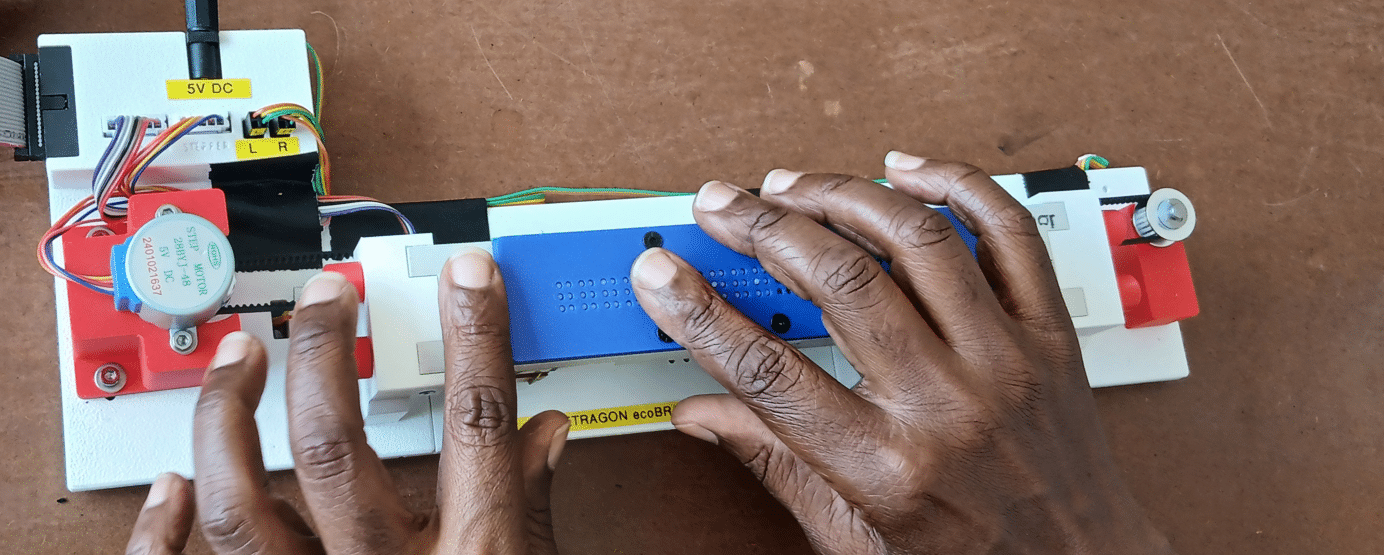
New, refreshable Braille displays, sometimes known as Braille terminals, attracted Zagler’s interest as an electrical engineer. Simply put, refreshable Braille displays are electro-mechanical devices that allow computer displays to be rendered haptically by means of a series of round tipped metal pins raised through holes in a flat surface. The engineering is not complex in itself, but the manufacture of these displays is convoluted and expensive; a line of twenty to eighty characters, or cells as they are known, costs anywhere between 3,000 and 10,000 euro.
As a committed Christian and devoted advocate of Louis Braille and his belief in the importance of communication to equality, the lack of available Braille displays outside of the well-funded social care systems concerned Zagler to the extent that it soon became the subject of his lifetime’s work.
After decades of experience at TU Wien, Zagler founded TETRAGON, an Austrian SME that now works with his team not only on the development of refreshable Braille displays but also on innovations in their manufacture to make them more easily affordable and more widely accessible. The need for the simplest displays in early years education is most pressing in economically developing regions.


Although the design of refreshable Braille displays can be complex, the manufacture of their component parts and final assembly is fairly straightforward.
The fact that labour costs play a big role encouraged TETRAGON to look for a manufacturing partner based where demand was high and labour costs were low.
Zagler and his team identified iZone Hub Makerspace, Zimbabwe’s self-styled “innovation hub for technology enthusiasts, makers and developers”. With the help of funding through Eureka’s Innowwide programme, TETRAGON and iZone Hub Makerspace began work together on a proof-of-concept project.
Zagler explained their collaboration the results far exceeded his expectations; anticipated communication and language problems barely ever arose. ”We had only to cancel one of our weekly video calls once because of a power outage in Harare”, Zagler recalls. “But apart from that, it was all unexpectedly easy, except for logistical and customs issues”.
The displays manufactured in Harare at iZone Hub to TETRAGON’s design and specifications cost half as much as those made in Vienna. And yet for all practical purposes they are virtually indistinguishable.
Meanwhile, extensive use of 3D-printing and microcomputing eliminated shipping costs and customs delays and simplified maintenance.
The outstanding success of the project was, in large part, Zagler believes, down to the people involved and their shared language and motivation.
That, and a clear understanding of the parties’ complimentary skills and responsibilities from the outset, supported positive international collaboration. Zagler believes that so long as those things in place, you can manufacture a simple refreshable Braille display with a startup and a garage workshop pretty much anywhere in the world.
“Sometimes low tech and low budget is just what works best”, he says with evident pleasure.
With co-creation involving TETRAGON and low-cost in-market manufacturing partners now well proven, TETRAGON will also offer designs for Braille keyboards and Braille embossers. TETRAGON is now partnering with the German SME Inventivio GmbH in a Eurostars project. The lessons learned for simple single-line Braille displays will be used in the design and manufacture of complex, refreshable tactile graphic e displays and their sales and marketing under the brand name Tactonom.
TETRAGON continues to pursue opportunities with partners in Kenya and Nigeria, as well as India, which is home to some 34 million people with mild or severe visual impairment. That is three and a half times the total population of Zagler’s native Austria.
It is easy to see parallels in the nature and scale of Louis Braille and Zagler’s ambition. Both men have been inspired by their religious beliefs and a drive to enrich education, communication and social inclusion for visually impaired people around the world.
Learn more about TETRAGON’s Braille activities on their website.
Through our funding programmes, national/regional funding bodies support SMEs, large companies, universities and research organisations conducting R&D and innovation projects together beyond borders to achieve great results. Learn more about our programmes and discover whether we have a funding opportunity for your organisation.
Eureka programme and project name: Innowwide AT-MiA
Countries involved: Austria, targeting Zimbabwe
Project duration: 2024
Got an innovative idea? Explore our funding opportunities designed to support groundbreaking projects and help turn your vision into reality.
Secure the resources you need to bring your ideas to life.
See all open calls